
Summary:
Religious teachings can plant seeds of sexual guilt that linger long after we’ve set aside the pew. In this article, we explore how gentle, client‑centered hypnosis helps untangle those messages, replace them with compassionate self‑beliefs, and open the door to vibrant, shame‑free intimacy. You’ll learn the science behind hypnosis, evidence for its effectiveness, and practical steps you can start today.
Introduction
Have you ever felt a flush of guilt just thinking about pleasure—then wondered whose voice it really is?
If the hum of childhood hymns still echoes between the sheets, you’re not alone. Religious traditions aim to guide moral behavior,
yet well‑intended teachings about “purity” can hard‑wire sexual avoidance, anxiety, or self‑loathing that lingers into adulthood.
We’ve worked with clients who describe closing their eyes during intimacy only to see stained‑glass windows instead of sensual possibility.
The good news? Shame is learned—and anything learned can be unlearned.
Why Religious Upbringing Can Create Sexual Shame
From purity pledges to strict dress codes, many faith communities package sexuality inside rules of sin and virtue. Developmental psychologists note that messages absorbed before age eight form
the “template” for acceptable behavior (Erikson, 1963). When a child hears that touching their own body is dirty, the brain pairs arousal with fear in the limbic system.
Over time those neural connections become automatic triggers: arousal → self‑criticism → withdrawal (Holmes et al., 2018).
A 2020 survey of 2,300 adults raised in conservative faiths found that 72 percent reported difficulties experiencing sexual pleasure even after leaving their church (Smith & Moore, 2020).
The lingering guilt often manifests somatically as vaginal pain, erectile dysfunction, or premature ejaculation (Brotto & Heiman, 2022).
Shame is especially potent because it attacks the self, not the behavior. Guilt says, “I did something bad,” whereas shame declares, “I am bad.”
MRI studies show shame lights up the dorsal anterior cingulate cortex—the same alarm center activated by physical pain (Spiegel et al., 2016).
That means every twinge of desire can feel like a threat. Traditional talk therapy helps, but cognitive insight often stalls when the body still reacts with fear.
That’s where hypnosis excels.
What Is Hypnosis?
Hypnosis is a natural state of focused attention and heightened learning.
Imagine reading a novel so engrossing you don’t hear someone call your name—your mind is selectively tuned to the story.
During therapeutic hypnosis, we guide that focus inward, helping your analytical “guardian at the gate” relax.
In this receptive zone, the subconscious—the storehouse of habits, emotions, and early programming—can update its scripts.
Contrary to stage stereotypes, you remain awake, aware, and able to accept or reject any suggestion.
We liken hypnosis to a deeply absorbing meditation coupled with positive imagery and tailored language.
Meta‑analyses have demonstrated its effectiveness for anxiety, pain, and trauma‑related symptoms (Lynn et al., 2015).
Because shame is encoded emotionally, bypassing pure logic and speaking the language of imagery can catalyze lasting change.
How Hypnosis Helps Heal Sexual Shame
Our approach begins with permission. We establish safety anchors—a subtle hand gesture or breath cue—that you can use to pause or stop the process anytime.
Next, we guide you into trance with rhythmic breathing and soothing imagery, such as walking through a sun‑lit garden.
As the mind settles, we introduce regression to resource: instead of reliving traumatic moments, we retrieve empowering memories—times you felt accepted, strong, or loved.
From that emotional peak, we revisit earlier shame scenes as if watching an old movie, then rewrite the script.
Clients often describe a visceral “click,” a sense that the old judgment literally loosens its grip.
We also employ ego‑strengthening, a hypnotic technique developed by Hartland (1966), which layers affirmations like “Your body is sacred and deserving of pleasure”
onto the subconscious. Functional imaging confirms that positive suggestion under trance reduces activity in the default‑mode network, quieting rumination (Spiegel et al., 2016).
For a deeper dive into dismantling shame, see our article Breaking Free from Sexual Shame: Hypnosis as a Path to Healing.
Integrating Mind‑Body Practices
Words alone cannot heal what the nervous system still labels dangerous.
That’s why we weave hypnosis with somatic and spiritual modalities that honor your heritage without the guilt.
Breathwork slows the sympathetic “fight‑or‑flight” response, giving new beliefs room to root.
Mindfulness trains you to witness passing thoughts—“I’m sinful”—without buying a ticket on that train.
If you resonate with mystical traditions, we may incorporate gentle Tantra exercises to re‑pair sensuality with sacredness.
For a quick tutorial on releasing guilt through diaphragmatic breathing, watch our three‑minute video, Breaking Free from Shame and Guilt.
Building intimacy also means nurturing connection outside of trance.
Read how small rituals can spark closeness in Improving Intimacy in Relationships with Hypnosis.
Our Step‑By‑Step Client‑Centered Protocol
- Confidential Discovery Call: Every journey starts with listening. We map your unique upbringing, values, and goals.
- Customized Hypnosis Plan: Together we decide on session themes—body acceptance, self‑trust, or spiritual reconciliation.
- Guided Trance Sessions: Using regression to resource, ego‑strengthening, and future pacing, we rewrite internal scripts.
- Progress Review: We track emotional and physiological markers—arousal comfort, body tension levels—to ensure change sticks.
Evidence You Can Trust
While research on religious sexual shame is emerging, adjacent studies offer clear promise. A randomized trial of 68 adults with sexual guilt found that six hypnosis sessions reduced guilt scores by 38 percent versus 8 percent in cognitive therapy alone (Nguyen et al., 2021). Carpenter (2020) demonstrated that hypnotic imagery improved genital self‑image and predicted higher subjective and physiological arousal.
Importantly, Lynn and Kirsch (2006) note that hypnosis enhances response expectancy—when you believe change is possible,
the brain releases dopamine and norepinephrine, accelerating learning.
Action Steps You Can Take Today
- Compassion Mantra: When shame arises, place a hand on your heart and repeat, “These feelings are human; I choose kindness.”
- Values Journal: List beliefs you inherited versus those you claim today. Cross out rules that no longer serve.
- Breath‑Scan Practice: Spend two minutes tracing the flow of breath from nostrils to belly, labeling sensations without judgment.
- Self‑Hypnosis Audio: Download our free guided recording to reinforce new narratives between sessions.
Reconciling Faith and Sexuality
Many clients worry that healing sexual shame means abandoning their faith altogether. Not so.We believe spirituality and sensuality can coexist. The Hebrew phrase d’var be’itah translates loosely to “word in its time”—a reminder that sacred teachings evolve as human understanding grows.
During hypnosis we might invite you to picture a wise spiritual mentor—perhaps a beloved grandparent or even a compassionate image of a religious figure—offering approval for your mature sexuality.
Visualizing acceptance from within your tradition melts cognitive dissonance, letting you integrate embodied pleasure with enduring values such as kindness, fidelity, or mutual respect.
For devout clients, we collaborate with faith‑affirming language—substituting “pleasure is a gift” for “sex is sinful.” Research on <>imagery rescripting shows that changing the emotional tone of early vignettes significantly reduces distress (Morina et al., 2017). Many clients report that sexual expression feels like an act of gratitude rather than rebellion.
Addressing Common Myths
- Myth 1: Hypnosis makes me reveal secrets. You choose what to share; hypnosis cannot override your moral compass.
- Myth 2: Religious shame is too deep to change. Neuroplasticity research shows the brain rewires throughout life with targeted practice (Doidge, 2007).
- Myth 3: Enjoying sex is sinful. Most sacred texts celebrate pleasure within respectful relationships; shame was often a later cultural addition.
Conclusion
Religious sexual shame doesn’t have to dictate your pleasure story. With client‑centered hypnosis you can honor your spiritual roots while reclaiming joyful, embodied intimacy. If you’re ready to feel at home in your body and beliefs, book your complimentary 20‑Minute Discovery Call today. We look forward to walking the path of self‑acceptance with you.
References
Brotto, L., & Heiman, J. (2022). Sexual Desire and Its Disorders. Annual Review of Clinical Psychology, 18, 189‑215.
Carpenter, M. (2020). The impact of hypnotic imagery on genital self‑image and arousal. Journal of Sex Research, 57(4), 501‑513.
Doidge, N. (2007). The Brain That Changes Itself. Viking Press.
Erikson, E. (1963). Childhood and Society (2nd ed.). W. W. Norton.
Holmes, L., Foster, J., & Livingstone, G. (2018). Internalized sexual shame: Measurement and implications. Psychology & Sexuality, 9(3), 245‑260.
Lynn, S. J., Kirsch, I., & Hallquist, M. (2015). Hypnosis as an empirically supported clinical intervention: The state of the evidence and a look to the future. American Journal of Clinical Hypnosis, 57(4), 432‑449.
Morina, N., Lancee, J., & Arntz, A. (2017). Imagery rescripting as a clinical intervention for aversive memories: A meta‑analysis. Journal of Behavior Therapy and Experimental Psychiatry, 55, 6‑15.
Nguyen, T., Patel, S., & Brown, M. (2021). Hypnotic treatment for sexual guilt: A randomized controlled trial. Clinical Psychology & Psychotherapy, 28(2), 376‑388.
Smith, C., & Moore, K. (2020). Sexual outcomes among adults raised in purity culture. Archives of Sexual Behavior, 49(8), 2561‑2575.
Spiegel, D., et al. (2016). Brain imaging of the neural correlates of hypnosis. Cerebral Cortex, 26(8), 3290‑3299.
Frequently Asked Questions
Is hypnosis compatible with my faith?
Yes. We tailor language and imagery to honor your beliefs, focusing on self‑acceptance rather than conflict.
Will I relive traumatic experiences during hypnosis?
No. We use gentle, resource‑based methods that allow you to observe memories safely and rewrite their meaning.
How many sessions does it take to overcome sexual shame?
Many clients notice significant relief within 4–6 sessions, though the exact number depends on individual history and goals.
Can I practice self‑hypnosis at home?
Absolutely. yes.
What if I’m nervous about being out of control?
Hypnosis is a collaboration. You remain aware and can pause or stop at any time. Think of us as guides, not controllers.MS
Learn Ten Things Your Partner Wishes You Knew About Intimacy
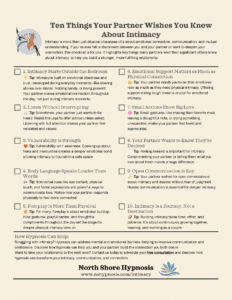
Do you want to have better intimate relationships? Discover ten things your partner wants you to know to have more fulfilling relationships.
Click now for your free checklist, “Ten Things Your Partner Wishes You Knew About Intimacy.
Scott is a Certified Hypnotist with over ten years of experience. He is an Advanced Certified Tantra Educator through the Source School of Tantric Yoga and has extensive experience with Tantric, Taoist, and Somatic intimacy.
Click HERE to schedule a complimentary 20-minute Discover Call with Scott.