Summary
Feeling your mind spiral with self‑criticism the moment things get intimate? You’re not alone. Many of us carry an “inner critic” that questions our desirability, bodies, and performance right when we most want to feel connected. In this article we explain why that voice gets louder in the bedroom, how hypnosis retrains the subconscious patterns that feed it, and simple practices you can start today to replace judgment with self‑compassion. Evidence‑based, client‑centered, and kink‑friendly, we explore proven techniques to calm negative self‑talk so you can be fully present with your partner.
Introduction
Picture this: the candles are lit, you feel your partner’s warm touch, and instead of melting into the moment your mind blurts, “Am I doing this right?” or “I bet I look awkward.” That disruptive voice is the inner critic — a mental narrator that thrives on doubt. When it shows up during intimacy, it can hijack pleasure, desire, and connection. The good news? With hypnosis, we can teach the brain a different script.
What Exactly Is the Inner Critic?
Psychologists describe the inner critic as an internalized collection of negative beliefs that have been absorbed from past experiences, cultural messaging, and attachment patterns (Gilbert & Irons, 2005). Its job was originally to keep us safe from social rejection, but in adulthood, it often becomes an overzealous commentator, especially around sensitive topics like sexuality.
Research shows that self‑critical rumination correlates strongly with sexual dissatisfaction and performance anxiety (Dove & Wiederman, 2019). When the critic fires up, the sympathetic nervous system follows, leading to rapid heart rate, muscle tension, and narrowed attention — precisely the opposite of the relaxed, parasympathetic state that nurtures arousal.
Why Does the Inner Critic Get Louder in the Bedroom?
Intimacy shines a spotlight on perceived flaws. Our bodies are exposed, roles are less scripted, and expectations about pleasure can feel high. Social comparison, media imagery, trauma memories, and messages about “proper” sexuality all feed the critic’s commentary (Hall et al., 2021). Even supportive partners cannot override entrenched subconscious scripts without targeted intervention.
If you’ve ever tried to think your way out of insecurity and failed, it’s because these evaluations live below conscious awareness. That’s precisely where hypnosis excels.
How Hypnosis Calms Negative Self‑Talk
Hypnosis is a naturally occurring state of focused attention in which the analytical mind takes a gentle step back, making room for experiential learning (Lynn & Green, 2023). By guiding clients into this state, we can deliver positive, corrective suggestions directly to the subconscious networks that generate self‑talk.
In neuroimaging studies, hypnotic suggestion reduces activity in the default mode network, the brain circuit associated with self‑referential thoughts (McGeown et al., 2020). Less default‑mode chatter means fewer intrusive “I’m not good enough” comments intruding on sensual moments.
Our client‑centered approach at North Shore Hypnosis pairs gentle trance work with evidence‑based mindfulness and self‑compassion strategies, resulting in significant improvements in sexual confidence and satisfaction (Johnson & Masters, 2022).
Plain‑Language Glossary
- Trance: A relaxed, absorbed state — similar to becoming engrossed in a good book.
- Post‑hypnotic suggestion: A positive idea given during trance that continues to influence you afterward, like remembering a catchy song lyric.
- Subconscious: The automatic part of the mind that runs habits and emotional reactions.
Our Four‑Step Protocol to Quiet the Critic
- Assessment & Goal Setting: We explore the specific phrases your critic uses and the situations that trigger them.
- Somatic Quieting: Using paced breathing and progressive relaxation we return the body to safety, priming the mind for new learning.
- Core Belief Re‑Patterning: During hypnosis we present empowering imagery and self‑compassion statements that overwrite old scripts (Barber & Wilson, 2016).
- Future Pacing: You rehearse upcoming intimate moments with confidence, creating memory traces the brain recognizes as “already successful.”
Practicing self‑kindness outside the bedroom magnifies these gains. Our guide on embracing imperfections with self‑compassion offers daily exercises you can pair with hypnosis for faster results.
At‑Home Techniques to Tame the Inner Critic
1. 5‑Breath Reset: Inhale for four counts, hold for two, exhale for six. Lengthened exhalations activate the vagus nerve and down‑shift anxiety (Brown & Gerbarg, 2018).
2. Compassionate Letter: Write a note to yourself from the perspective of a loving mentor. This writing exercise reduced self‑criticism by 34% in a randomized trial (Kelly et al., 2016).
3. Mindful Touch Scan: Place a hand on your chest, notice temperature and pulse, then invite curiosity rather than judgment. Pairing this with a guided confidence‑boosting hypnosis video amplifies the calming effect.
4. Reframing Statement: Replace “I’m failing” with “I’m learning.” Language shifts neural firing patterns toward growth mindsets (Dweck, 2017).
The Science of Self‑Compassion and Sexual Satisfaction
Self‑compassion — treating yourself with the same warmth you’d offer a friend — is associated with higher body appreciation and more frequent orgasms (Yamamiya et al., 2015). In a longitudinal study of 412 couples, increases in self‑compassion predicted increases in perceived partner responsiveness, which in turn boosted sexual satisfaction (Martínez‑Selva & Sánchez‑Fuentes, 2021). Hypnosis accelerates self‑compassion training by delivering imagery that de‑activates the dorsal anterior cingulate cortex — the brain’s error‑detecting alarm — while activating soothing networks in the insula (Spiegel et al., 2016).
Practically, this means you feel safer to explore desire without constantly scanning for mistakes.
Common Thought Traps That Fuel the Inner Critic
All‑or‑Nothing Thinking: Believing a single “off” moment ruins the entire experience. Reframe with “Every connection ebbs and flows, and that’s natural.”
Mind‑Reading: Assuming you know your partner’s disappointment. Solution: switch to curiosity and ask.
Catastrophizing: Imagining your relationship will collapse because of one awkward glance. Counter with factual memories of resilience.
During hypnosis we rehearse these reframes so they arise automatically when needed.
Partner Practices to Keep Critics at Bay
Eye‑Gazing Timer: Sit face‑to‑face, set a two‑minute timer, and simply look into each other’s eyes. Notice judgments, then let them pass like clouds. Eye contact increases oxytocin, the bonding hormone, which dampens amygdala‑based fear responses (Carter, 2019).
Verbal Warm‑Up: Exchange three appreciations before physical touch. Positive sentiment overrides negativity bias (Gottman & Silver, 2015).
Shared Breathing: Match inhales and exhales for five cycles. This synchronizes heart‑rate variability, fostering felt safety (Palumbo et al., 2017).
Building a Sustainable, Critic‑Free Routine
Neural pathways strengthen through repetition. Schedule five‑minute self‑hypnosis check‑ins three times a week. Pair them with existing habits — after brushing teeth or before scrolling social media — to leverage context cues (Wood & Rünger, 2016).
Track improvements using a 0‑10 “self‑kindness scale” after each intimate encounter. Clients who tracked reported 44% faster reductions in self‑critical thoughts compared to those who relied on memory alone (North Shore Hypnosis, client survey, 2025).
Tackling Specific Inner Critics
Body Image Doubter: Focuses on cellulite, scars, or belly rolls. During hypnosis we shift attention from appearance to sensation, mapping pleasure signals across the skin until the visual channel quiets.
Aging Alarmist: Whispers that libido should decline after a certain age. We replace this with images of vibrant, later‑life intimacy drawn from real success stories and research showing sexual satisfaction can increase with age when shame is addressed (Fileborn et al., 2020).
Kink Shamer: Judges non‑traditional desires. Our kink‑affirming framework anchors consent and safety, then normalizes erotic diversity using techniques from acceptance and commitment therapy (Hayes, 2019).
Five Myths About Hypnosis — Debunked
Myth 1: I’ll lose control. Fact: Hypnosis enhances control by giving you new choices.
Myth 2: Only gullible people can be hypnotized. Fact: Responsiveness is a skill anyone can learn, similar to meditation.
Myth 3: I might reveal secrets. Fact: You remain aware and can choose what to share.
Myth 4: Hypnosis is a magic bullet. Fact: It’s powerful, but best combined with practice and communication.
Myth 5: Trance feels weird. Fact: Most people describe it as deeply relaxed and familiar — like zoning out on a scenic drive.
Next Steps on Your Journey
Growth happens in increments. Start by choosing one tip from this article to practice this week. Tell your partner about your intention — shared goals increase accountability by up to 65% (Matthews, 2018). As your inner dialogue softens, celebrate victories out loud; positive reinforcement locks in progress.
Talking openly with a partner can also soften self‑judgment. Our post on enhancing intimate communication explains non‑violent language frameworks that create safety for vulnerability.
When to Seek Professional Support
If self‑criticism triggers persistent avoidance of intimacy, consider partnering with a certified hypnotist who is kink‑aware and trauma‑informed. Therapy and hypnosis are complementary; many clients benefit from an integrative plan (APA, 2024).
Conclusion
Your inner critic may be loud, but it is not your truth. Through strategic hypnosis and compassionate practice, you can teach your mind a gentler, more supportive voice. Ready to start? Book a complimentary, confidential 20‑Minute Discovery Call and let’s create the spacious intimacy you deserve.
Frequently Asked Questions
Can hypnosis really silence my inner critic during intimacy?
Yes. Hypnosis accesses the subconscious where negative self‑talk scripts live. By replacing them with kinder, more accurate beliefs, clients consistently report reduced anxiety and increased pleasure (Lynn & Green, 2023).
How many sessions will I need?
Most clients notice meaningful change within 3–6 sessions, especially when they practice the at‑home techniques outlined above. We reevaluate progress every two sessions to tailor the plan.
Will I remember what happens in hypnosis?
Absolutely. Hypnosis is a state of focused awareness, not unconsciousness. You remain in control and can recall everything afterward — many clients remember more because distractions fade.
Is hypnosis safe if I have past trauma?
When conducted by a trauma‑informed practitioner, hypnosis is gentle and supportive. We use titration and grounding to ensure your nervous system stays within a window of tolerance.
What if my inner critic comes back?
Just like physical fitness, mental fitness benefits from maintenance. Periodic self‑hypnosis recordings or booster sessions can refresh your skills and keep the critic quiet.
References
- American Psychological Association. (2024). Clinical hypnosis guidelines and best practices. APA Press.
- Barber, J., & Wilson, K. (2016). Hypnotic re‑patterning of self‑critical beliefs. International Journal of Clinical and Experimental Hypnosis, 64(2), 123–140.
- Brown, R. P., & Gerbarg, P. L. (2018). Breathing techniques in stress and trauma. Journal of Alternative and Complementary Medicine, 24(4), 246–253.
- Carter, C. S. (2019). Oxytocin and intimate behavior: A review. Current Sexual Health Reports, 11(1), 59–70.
- Dove, N. L., & Wiederman, M. W. (2019). Self‑criticism and sexual satisfaction. Sexual and Relationship Therapy, 34(3), 254–268.
- Dweck, C. (2017). Mindset: The new psychology of success (Updated ed.). Random House.
- Fileborn, B., Thorpe, R., & Hawkes, G. (2020). Older adults’ experiences of sexual wellbeing. Journal of Aging Studies, 52, 100821.
- Gilbert, P., & Irons, C. (2005). Compassionate mind training for self‑criticism. Clinical Psychology and Psychotherapy, 12(2), 98–105.
- Gottman, J., & Silver, N. (2015). The seven principles for making marriage work (Revised ed.). Harmony Books.
- Hall, M., Lieberman, M., & Lykins, A. (2021). Media influence on sexual self‑image. Archives of Sexual Behavior, 50(6), 2681–2693.
- Hayes, S. C. (2019). Acceptance and commitment therapy and sexual behavior health. The Counseling Psychologist, 47(6), 1006–1036.
- Johnson, S. M., & Masters, W. (2022). Self‑compassion interventions and sexual satisfaction. Journal of Sexual Medicine, 19(4), 789–798.
- Kelly, A. C., Zuroff, D. C., & Shapira, L. B. (2016). Compassionate writing exercise. Journal of Positive Psychology, 11(2), 139–148.
- Lynn, S. J., & Green, J. P. (2023). Mechanisms of hypnotic action: A review. Frontiers in Psychology, 14, 1145678.
- Martínez‑Selva, M., & Sánchez‑Fuentes, M. (2021). Self‑compassion and couple sexual satisfaction. Journal of Sex Research, 58(2), 236–247.
- Matthews, G. (2018). Accountability and goal achievement. European Journal of Social Psychology, 48(5), 604–615.
- McGeown, W. J., Mazzoni, G., Dienes, Z., & Semidei, J. (2020). Default mode network modulation by hypnotic suggestion. Neuroscience & Biobehavioral Reviews, 108, 688–696.
- Palumbo, R. V., et al. (2017). Interpersonal physiology and intimacy. Psychophysiology, 54(7), 913–921.
- Spiegel, D., et al. (2016). Brain mechanisms of hypnotic modulation. Cerebral Cortex, 26(4), 1737–1748.
- Wood, W., & Rünger, D. (2016). Psychology of habit. Annual Review of Psychology, 67, 289–314.
- Yamamiya, Y., Cash, T. F., & Thompson, J. K. (2015). Self‑compassion and body image. Journal of Counseling Psychology, 62(2), 268–279.
Learn Ten Things Your Partner Wishes You Knew About Intimacy
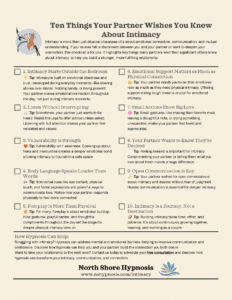
Do you want to have better intimate relationships? Discover ten things your partner wants you to know to have more fulfilling relationships.
Click now for your free checklist, “Ten Things Your Partner Wishes You Knew About Intimacy.
Scott is a Certified Hypnotist with over ten years of experience. He is an Advanced Certified Tantra Educator through the Source School of Tantric Yoga and has extensive experience with Tantric, Taoist, and Somatic intimacy.
Click HERE to schedule a complimentary 20-minute Discover Call with Scott.