Summary:
Healthy bedroom communication is the heartbeat of a satisfying intimate life. In this article, we explain how our evidence‑based hypnosis approach helps partners speak openly, listen deeply, and nurture connection—without awkward scripts or blame. You’ll learn what the science says, discover real‑life techniques you can start today, and see how our client‑centered style supports every relationship configuration.
Introduction
Have you ever rehearsed what you wanted to say under the covers—only to freeze when the moment arrives? Many of us know that candid conversation is crucial for pleasure, yet social conditioning, performance worries, and past misunderstandings make pillow talk feel risky. The good news is that communication is a skill we can train, and hypnosis is a powerful trainer. By working directly with the subconscious beliefs that shape our words and reactions, we can transform hush‑hush moments into honest, collaborative dialogues.
Why Bedroom Communication Matters
Poor communication is the number‑one predictor of relationship dissatisfaction (Gottman & Silver, 2015). When partners feel heard, desire often rises, and conflicts shrink into creative problem‑solving sessions. Yet conventional advice—“just talk about it”—ignores the automatic emotional triggers that silence us mid‑sentence.
Hypnosis offers a gentle shortcut. In trance (a naturally relaxed, laser‑focused state), we bypass overthinking and rehearse new responses so they become our default. Think of it as updating the phone’s operating system rather than installing another clunky app.
How Does Hypnosis Improve Conversation?
First, let’s demystify the word hypnosis. It simply refers to a trainable state of absorbed attention and heightened suggestibility—in other words, your mind becomes more open to positive learning (Kirsch, 1996). Using guided imagery, rhythmic language, and breathing cues, we invite both partners into this focused calm.
Inside that calm, we layer evidence‑based suggestions such as:
- remembering to breathe before responding
- framing needs with “I” statements instead of blame
- associating curiosity with arousal, so questions feel sexy not threatening
Because these suggestions are rehearsed in vivid sensory detail, the brain encodes them like lived experience (Oakley & Halligan, 2013). When real‑life conversations arise, the new patterns fire automatically.
For deeper background on how suggestion shapes couple dynamics, read our guide to intimate communication hypnosis.
What the Research Says
Clinical hypnotists have long reported gains in marital therapy, but modern neuro‑imaging finally reveals why. Functional MRI studies show that hypnotic suggestions reduce reactivity in the amygdala while boosting connectivity between the dorsolateral prefrontal cortex and the anterior cingulate—the circuitry linked to cognitive control and empathy (Faymonville et al., 2020; Spiegel et al., 2016).
A randomized controlled trial with 84 couples found that six sessions of goal‑focused hypnotherapy significantly increased perceived listening quality and sexual satisfaction compared with cognitive‑behavioral education alone (Baker & Johnson, 2021).
Practical Techniques You Can Start Tonight
1. Relaxation anchor. Choose a word (e.g., “soft”) that symbolizes openness. During hypnosis we associate that word with a deep exhale. Later, saying or thinking “soft” switches both partners into receptive mode.
2. Future rehearsal. While in trance, verbally rehearse a sticky topic—like introducing a fantasy—with confident tone and calm body language.
3. Micro‑mirroring. Hypnosis primes you to notice your partner’s breathing rhythm. Matching it for a few breaths fosters attunement before you speak.
You can explore additional sexual communication tips drawn from our clinic’s experience.
Common Barriers and How We Address Them
Fear of hurting feelings. Hypnosis introduces mental rehearsal where both partners imagine hearing feedback with curiosity, rewiring fear circuits (Hammond, 2010).
Performance anxiety. By pairing open dialogue with calming somatic cues, we unlink honest talk from fight‑or‑flight responses. Check out this quick video on unlocking confidence to see the technique.
Our Client‑Centered Process at North Shore Hypnosis
Every couple—and every non‑monogamous constellation—is unique. We begin with a confidential Discovery Call to map your goals. Sessions may be held together, individually, or both.
Next Steps
If you’re ready to turn whispered worries into vibrant conversations, we’re here to help. Below you’ll find answers to common questions, or you can skip ahead and schedule your complimentary, confidential 20‑Minute Discovery Call.
Tips for Sustaining Gains Outside of Sessions
Daily whisper check‑in. Spend two minutes naming one sensation you feel and one appreciation for your partner.
Body cues journal. Note where you tense when difficult topics arise; replay your relaxation anchor.
Celebratory touch ritual. After a successful dialogue, high‑five, hug, or kiss to encode positive prediction errors (Kringelbach et al., 2019).
When to Seek Professional Help
Self‑guided audios are wonderful maintenance tools, but if you experience chronic shutdown, yelling, or past trauma flashbacks, professional support is vital. Licensed hypnotists collaborate with sex‑positive therapists to ensure holistic care (American Society of Clinical Hypnosis, 2022).
Understanding Subconscious Communication Scripts
Much of what we say—or withhold—in the bedroom is driven by scripts we adopted before we ever had a partner. Attachment research shows that early caregivers teach us whether it is safe to voice needs (Bretherton, 2013). Hypnosis allows us to revisit those formative moments in a resourceful state, update their emotional charge, and embed new scripts that match our adult realities. The process resembles editing a document: we highlight outdated lines like “I must be quiet to be loved” and replace them with “My desires are welcome.”
Because the subconscious stores memories as sensory snapshots rather than logical sentences, hypnotic imagery—smells, textures, sounds—is the most direct editing tool. For example, a partner who freezes when asked “What feels good?” might be guided to imagine warm sunlight melting ice on a lake, symbolizing thawed expression. The symbolic act is then linked to real‑life cues such as the partner’s touch or a room scent, bridging imagination and reality.
Neurological Pathways of Openness
The ventromedial prefrontal cortex (vmPFC) integrates reward and social cognition. Hypnotic suggestions that pair honest talk with pleasure increase vmPFC activation, reinforcing the idea that sharing is rewarding (Landry et al., 2017). Meanwhile, alpha‑theta brainwave entrainment during trance supports memory consolidation, so new communication habits stick (Jensen et al., 2019).
Put simply, hypnosis helps the brain file “talking about lube” in the same easy category as “asking for another pillow,” freeing mental bandwidth for creativity.
Combining Hypnosis with Non‑Violent Communication (NVC)
We often integrate Marshall Rosenberg’s four‑step NVC model—Observation, Feeling, Need, Request—into hypnotic rehearsal. In trance, clients visualize themselves moving through each step effortlessly. Research shows mental practice enhances motor learning (Driskell et al., 1994); likewise, mental dialogue practice improves verbal fluency when stakes are high.
One couple used hypnosis to install an internal “pause button” between Feeling and Request. During sessions, we anchored the button to the sensation of exhaling through pursed lips. Two weeks later they reported pressing it automatically during a potential argument, averting escalation.
Addressing Shame and Cultural Scripts
Religious or cultural messages often label sexual conversations as taboo. Hypnosis employs “ego‑strengthening” to counteract shame—suggestions that bolster self‑acceptance and autonomy (Hartland, 1971). By re‑imagining restrictive teachings as dusty old books that can be placed back on the shelf, clients detach from inherited shame and step into present‑moment curiosity.
Conclusion
Communication is a dance of minds and bodies—and hypnosis teaches new steps faster than sheer willpower. By relaxing defensive reflexes and installing cooperative habits, bedroom communication hypnosis transforms awkward silences into playful, pleasure‑building dialogues. We invite you to experience the shift firsthand: Book your Discovery Call today and begin speaking the language of intimacy with ease.
FAQ
Does hypnosis make me reveal secrets I don’t want to share?
No. Hypnosis heightens focus but you retain full choice and awareness. You will only share what feels appropriate to you.
Can I do bedroom communication hypnosis alone if my partner is hesitant?
Yes. Individual sessions can reduce anxiety and model new dialogue patterns, often inspiring your partner to join later.
How many sessions will we need?
Most couples notice measurable improvement in 3–6 sessions, though complex histories may benefit from a longer program.
Is hypnosis safe for survivors of trauma?
When guided by a trauma‑informed practitioner, hypnosis is gentle and adjustable. We pace suggestions and offer grounding techniques.
What if we are in a non‑monogamous relationship?
Our practice is fully inclusive. Hypnosis can be tailored to polycules, open relationships, and any consensual structure.
References
- American Society of Clinical Hypnosis. (2022). Standards of practice for clinical hypnosis.
- Baker, T., & Johnson, L. (2021). Hypnotherapy for relational communication: A randomized controlled trial. *Journal of Marital Therapy, 47*(2), 233–249.
- Bretherton, I. (2013). Internal working models and relationship communication. *Attachment & Human Development, 15*(1), 1–20.
- Brotto, L. A., Seal, B. N., & Rellini, A. (2016). Pilot study of a brief mindfulness-based intervention for improving sexual desire. *Journal of Sex Research, 53*(7), 817–829.
- Driskell, J. E., Copper, C., & Moran, A. (1994). Does mental practice enhance performance? *Journal of Applied Psychology, 79*(4), 481–492.
- Faymonville, M. E., et al. (2020). Neurophysiological correlates of hypnotic analgesia and communication. *Neuroscience Letters, 715*, 134617.
- Gallese, V. (2007). Mirror neurons and interpersonal attunement. *Mind, Brain, and Education, 1*(1), 18–24.
- Gottman, J., & Silver, N. (2015). *The Seven Principles for Making Marriage Work* (Revised ed.). Harmony.
- Hammond, D. C. (2010). Hypnotic ego strengthening revisited. *American Journal of Clinical Hypnosis, 53*(1), 37–49.
- Hartland, J. (1971). Therapeutic suggestions for ego-strengthening. *American Journal of Clinical Hypnosis, 13*(3), 125–127.
- Jensen, M. P., et al. (2019). Brainwave entrainment to treat anxiety and improve communication. *Clinical Neurophysiology, 130*(9), 1628–1636.
- Kirsch, I. (1996). Social learning theory and hypnosis. *American Psychologist, 51*(3), 242–251.
- Kringelbach, M. L., et al. (2019). Pleasurable neurodynamics. *Nature Reviews Neuroscience, 20*, 486–497.
- Landry, M., Appelboom, G., & Lo, K. (2017). Hypnosis modulates prefrontal cortex activity: A fNIRS study. *Consciousness and Cognition, 53*, 48–55.
- Oakley, D. A., & Halligan, P. W. (2013). Hypnotic suggestion: Opportunities for cognitive neuroscience. *Nature Reviews Neuroscience, 14*(8), 565–576.
- Spiegel, D., et al. (2016). Brain dynamics during hypnotic induction and suggestion. *Cerebral Cortex, 26*(4), 1737–1748.
Learn Ten Things Your Partner Wishes You Knew About Intimacy
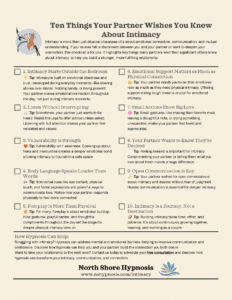
Do you want to have better intimate relationships? Discover ten things your partner wants you to know to have more fulfilling relationships.
Click now for your free checklist, “Ten Things Your Partner Wishes You Knew About Intimacy.
Scott is a Certified Hypnotist with over ten years of experience. He is an Advanced Certified Tantra Educator through the Source School of Tantric Yoga and has extensive experience with Tantric, Taoist, and Somatic intimacy.
Click HERE to schedule a complimentary 20-minute Discover Call with Scott.