
Summary
Fear of commitment is rarely about the other person—it’s about the stories our nervous system tells us to stay “safe.” In this article, you’ll learn:
- How childhood attachment, stress chemistry, and cultural myths wire the commitment-phobic brain.
- Why hypnosis—especially a client-centered, Tantra-informed approach—rewrites those stories at the subconscious level.
- Simple self-hypnosis and somatic practices you can start today to move from protective avoidance to courageous connection.
- When to seek professional help and how North Shore Hypnosis can guide you into commitment confidence.
Why “I’m Just Not Ready” Usually Isn’t the Real Issue
Have you ever found yourself saying “This relationship is perfect, but…” and bolting as soon as things get serious? You’re not alone. Surveys suggest up to 40 % of adults experience some level of commitment anxiety. But the reasons run deeper than liking your personal space or wanting more life experience.
Stress Chemistry & Subconscious Safety
Commitment means vulnerability. The limbic system interprets emotional risk much like physical danger, flooding the body with stress hormones. If your stress baseline is already elevated—perhaps from chronic worry, sleep debt, or pandemic-era uncertainty—commitment can feel like pouring gasoline on a smoldering fire. (Explore how stress affects physiology in this post on stress effects.)
Hidden Secondary Gains
That anxious voice might also be protecting secondary gains—the hidden benefits of staying uncommitted, such as freedom from accountability or avoidance of potential heartbreak. We unpack this dynamic in our secondary-gains article.
Attachment Imprints
If early caregivers were inconsistent, adult intimacy can trigger old “I’ll be abandoned” scripts. Attachment style isn’t destiny, but it is a subconscious program—exactly the level where hypnosis excels.
How Hypnosis Rewires Commitment Anxiety
Hypnosis is a focused, relaxed state where the critical mind softens and new patterns can be installed—think of it as upgrading the relationship firmware. If you’re new to the concept, see What Is Hypnosis?
- Calming the Physiological Alarm
Guided trance slows breathing, balances the autonomic nervous system, and lowers cortisol—mechanisms detailed in The Science Behind Hypnosis for Stress Reduction. When the body feels safe, the heart can open.
- Updating the Inner Narrative
Using imagery and carefully crafted suggestions, we replace “Commitment = loss of freedom” with “Commitment = chosen intimacy and mutual growth.” The subconscious loves metaphor; together we might picture two independent trees whose roots intertwine yet still reach for their own sunlight.
- Resolving Past Emotional Charges
Through client-centered regression or parts therapy we release stuck emotions from previous relationship wounds—preventing them from hijacking the present.
- Installing Future Confidence
Finally, we rehearse successful commitment scenarios so your brain encodes them as familiar rather than frightening—similar to how athletes prime peak performance learn more here.
Weaving Tantra, Taoist & Somatic Wisdom
Because I’m an Advanced Certified Tantra Educator, our work also integrates:
- Breathwork & Micro-Cosmic Orbit – to move anxious energy out of the chest and into grounding channels.
- Eye-gazing & Heart Coherence – repairing nervous-system attunement with a partner.
- Somatic Awareness Drills – tracking early body cues of shutdown so you can choose differently before self-sabotage kicks in.
These embodied practices transform hypnosis from “mind work” into full mind-body rewiring.
Signs You’re Ready to Break the Pattern
- You notice a repeating arc: intense attraction → future talk → panic → exit.
- You catastrophize minor conflicts into “proof” the relationship will fail.
- Long-term partners complain you keep one foot out the door.
- You secretly crave stability but date only “unavailable” people.
- Fantasies of commitment feel good in theory—until they’re real.
If two or more statements resonate, you’re a prime candidate for commitment-confidence coaching.
Five Practical Steps You Can Start Today
- Mini Self-Hypnosis (5 minutes)
- Sit comfortably, eyes closed.
- Inhale for 4 counts, exhale for 6. Feel the chair support you.
- Mentally repeat: “It’s safe to explore deeper connection.”
- Visualize holding hands with a future partner while still feeling light and free.
- Anchor the calm by pressing thumb and forefinger together. Use the anchor whenever anxiety spikes.
- Journaling Secondary Gains
List the perks you think you’ll lose in a committed relationship. Identify healthier ways to meet those needs—e.g., freedom through honest scheduling rather than withdrawal.
- Gradual Exposure
Practice small “commitments”: plan a weekend trip four weeks ahead, adopt a plant that requires daily watering, or join a six-week class. Each micro-success trains the brain that commitment can be rewarding.
- Bilateral Stimulation Walk
Walk while gently tapping alternate shoulders; this left-right rhythm calms the amygdala see our bilateral-stimulation guide. During the walk, imagine future commitment scenes.
- Sleep Hygiene
Fear flares when we’re exhausted. Pair the above with techniques from Hypnosis for Better Sleep.
When to Seek Professional Support
- Patterns persist despite self-help.
- Commitment anxiety co-occurs with panic attacks or depression.
- You and your partner cycle between closeness and rupture, eroding trust.
A client-centered hypnotist offers personalized scripts, handles subconscious resistance, and integrates couples-friendly techniques.
What to Expect at North Shore Hypnosis
- Complimentary Discovery Call – confirm fit and goals.
- Tailored Intake – uncover attachment themes, Tantra interests, stress triggers.
- Progress Check-Ins – celebrating milestones builds momentum.
Ready to step into secure, thriving love?
Book a free Discovery Call with North Shore Hypnosis and become commitment confident now.
Frequently Asked Questions (FAQ)
- Can hypnosis make me commit against my will?
No. Hypnosis enhances your own motivations; it cannot force unwanted actions.
- How many sessions will I need?
Most clients notice change in 3–6 sessions, though deeper attachment wounds may take longer.
- Will I lose my independence in a committed relationship?
Healthy commitment supports individuality. Hypnosis helps you anchor self-expression within partnership.
- Is online hypnosis as effective as in-office work?
Yes. Studies show comparable outcomes. Our secure Zoom sessions include live somatic guidance.
- Can my partner join the session?
Absolutely—couples sessions accelerate trust-building and mutual understanding.
Learn Ten Things Your Partner Wishes You Knew About Intimacy
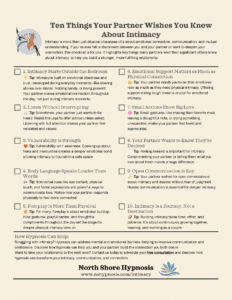
Do you want to have better intimate relationships? Discover ten things your partner wants you to know to have more fulfilling relationships.
Click now for your free checklist, “Ten Things Your Partner Wishes You Knew About Intimacy.
Scott is a Certified Hypnotist with over ten years of experience. He is an Advanced Certified Tantra Educator through the Source School of Tantric Yoga and has extensive experience with Tantric, Taoist, and Somatic intimacy.
Click HERE to schedule a complimentary 20-minute Discover Call with Scott.